Record crack opening and closing
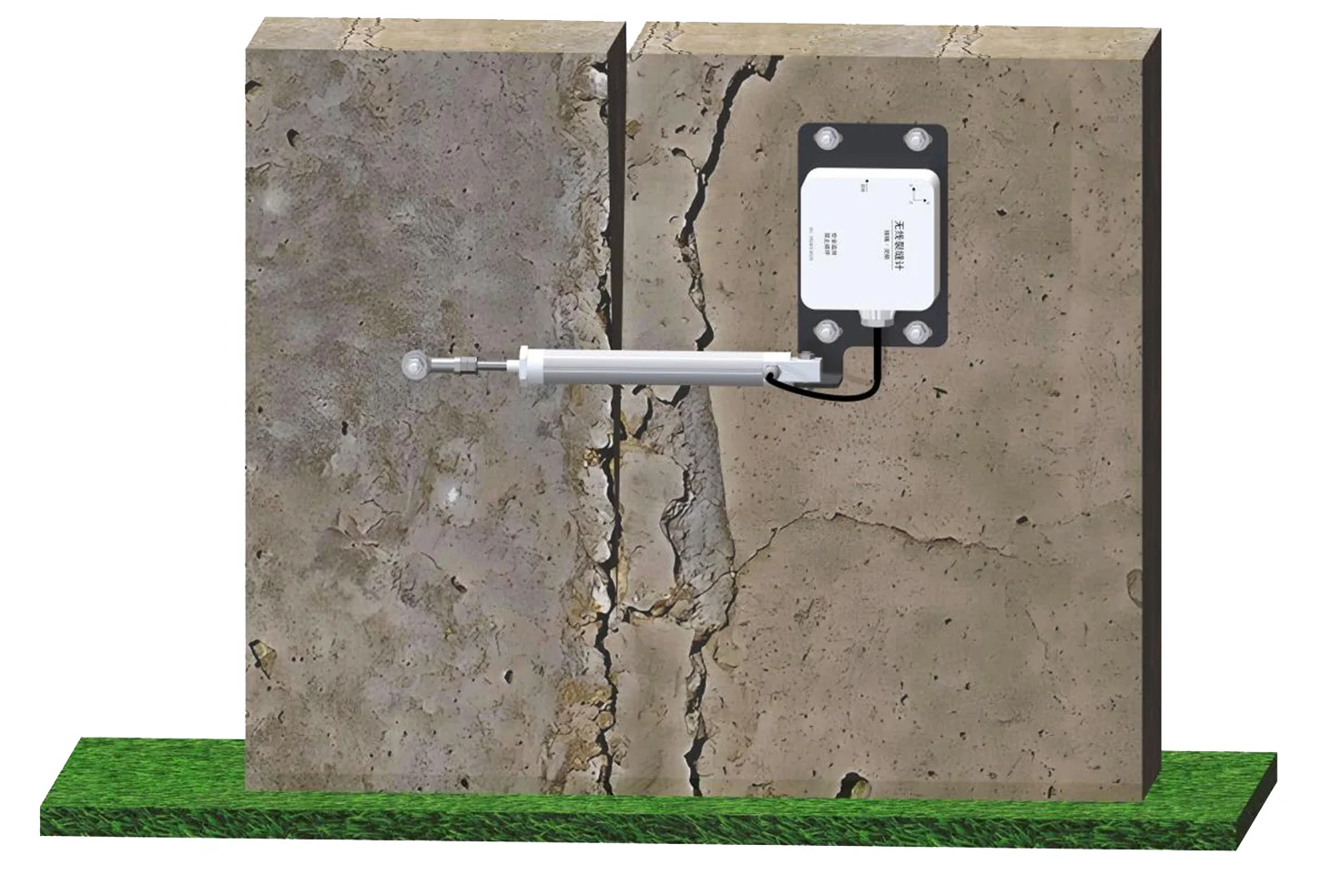
A sliding-resistor displacement sensor measures crack movement. Choose a 100mm, 200mm or 500mm range for the expected change. Displacement resolution is 0.01mm and accuracy is 0.05% of full scale.

Wireless crack monitoring
The RT-1080 integrates displacement acquisition, battery power and 4G communications. Scheduled reporting and crack-change triggers record deformation over time. An optional tilt sensor adds structural orientation measurements. Triggering based on changes in tilt or acceleration is available as an option. Applications include building cracks, bridge expansion joints, unstable rock masses and heritage structures.
Benefits
A sliding-resistor displacement sensor measures crack movement. Choose a 100mm, 200mm or 500mm range for the expected change. Displacement resolution is 0.01mm and accuracy is 0.05% of full scale.
Remotely adjust storage intervals, reporting intervals and crack-change thresholds. Routine reports follow the configured schedule, with additional reports triggered by crack changes. Tilt-change triggering and acceleration-change triggering are optional features. Operation is rated at 60 months with 4-hour reporting.
The lithium thionyl chloride battery, data acquisition and 4G Cat.1 communications are integrated into the device, reducing external power and data wiring. The 4G Cat.1 configuration supports Southeast Asia, Japan and Europe. Confirm cellular coverage at each monitoring location.
The optional three-axis tilt sensor adds orientation measurements alongside crack displacement. With this option, tilt accuracy is ±0.005° within ±90°.
Applications
Specifications
Product support
Contact our technical team for current product information and project configuration.
Discuss your monitoring requirementsThe tilt sensor is optional, with an accuracy of ±0.005° within ±90°. Select the required measurement configuration for the project.
Crack-change triggering is supported. Tilt-change triggering and acceleration-change triggering are optional features; select the configuration required for the project.
No. It is displacement resolution. Displacement accuracy is 0.05% of full scale and depends on the selected range.
A lithium thionyl chloride battery powers the device for 60 months at a 4-hour reporting interval.