Three-axis tilt
Track tilt in three dimensions to analyze orientation, inclination direction and long-term trends.

Tilt and vibration monitoring
Measure three-axis tilt, acceleration, dominant frequency and amplitude. Internal sampling at 2000Hz and real-time spectrum analysis support static and dynamic monitoring of bridges, tunnels, slopes and other structures.
Measurements
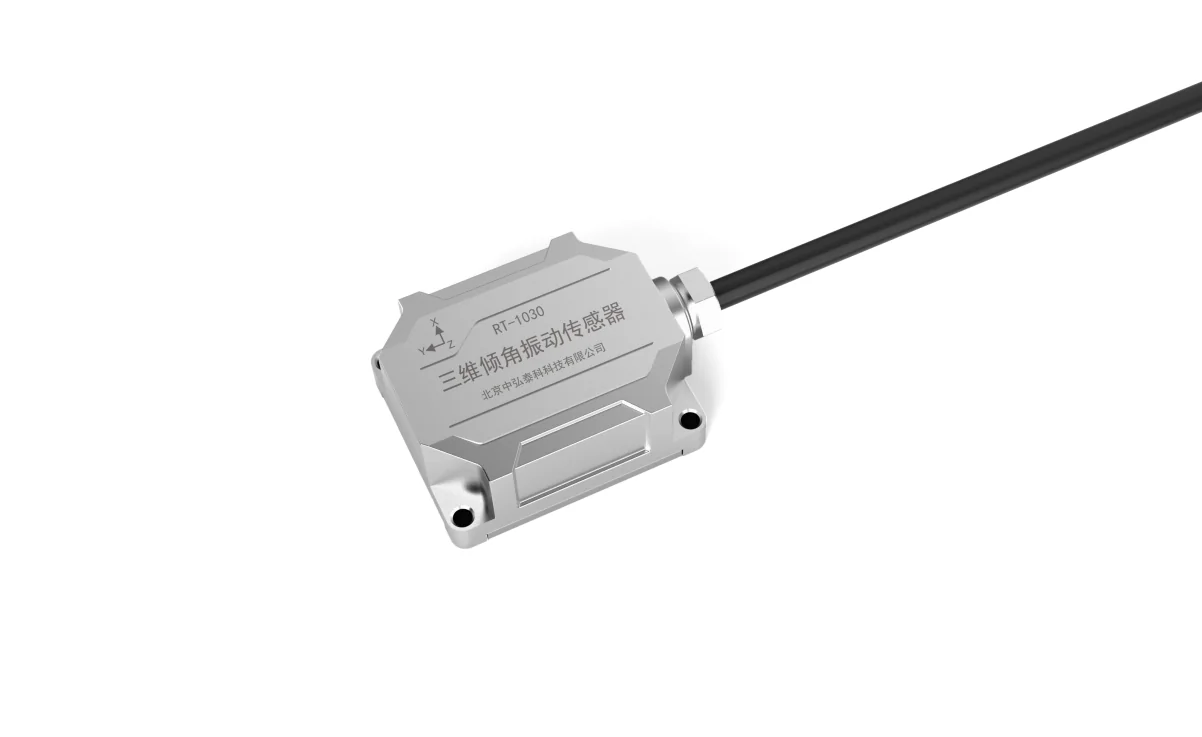
The RT-1030 measures three-axis tilt and vibration. High-speed sampling and spectrum analysis provide acceleration, dominant frequency and its amplitude to track slow inclination and changing dynamic response.
Track tilt in three dimensions to analyze orientation, inclination direction and long-term trends.
Measure acceleration during vibration to analyze changes in dynamic response.
Identify the main frequency component of the vibration spectrum and track changes over time.
Measure the amplitude associated with the dominant frequency to describe its response intensity.
Installation
Fix the sensor through its mounting holes to the structure or a suitable bracket. Record the orientation using the housing coordinate marks. Installation angle is flexible; a level mounting surface helps achieve the specified tilt accuracy.
Choose a flat, stable point that moves with the monitored structure and fasten the sensor firmly.
Use the coordinate marks on the housing to identify and record the measurement direction.
Aim for a position close to 0°. Tilt accuracy remains 0.005° throughout the ±30° range.
Benefits
The RT-1030 brings together static orientation measurement, dynamic response analysis, onboard processing and system integration for long-term structural monitoring.
One device measures tilt and vibration, reducing the work of installing and integrating separate sensors.
Internal sampling and spectrum analysis provide dominant frequency and amplitude directly, reducing processing in the host system.
Choose polling or active reporting, output fields and reporting frequency according to the monitoring objective, communications and power conditions.
Temperature compensation, reverse-polarity protection, lightning and electrostatic protection, and IP68 sealing support outdoor operation.
Applications
Suited to points where both gradual inclination and dynamic vibration need to be observed.
Track tilt and vibration characteristics at key positions under traffic and other loads.
Monitor orientation and vibration during construction and operation.
Track inclination and dynamic disturbance at selected points to support deformation trend analysis.
Provide tilt and vibration data at structural monitoring points for continuous monitoring and system integration.
Specifications
Product support
Contact our technical team for current product information and project configuration.
Discuss your monitoring requirements2000Hz is used internally for vibration sampling and spectrum analysis. The selectable 1Hz, 5Hz, 10Hz or 20Hz rate controls how frequently tilt or acceleration readings are sent to the acquisition system. Select the reporting rate for the monitoring objective and available communications.
Polling suits acquisition equipment that queries several sensors on a schedule. Active reporting suits monitoring points that need frequent updates. Consider sensor quantity, reporting frequency, bandwidth and power conditions.