Wireless crack monitoring

Model RT-1060Wireless Crackmeter (Draw-Wire)

Draw-wire movement measurements with event reporting

The RT-1060 is a wireless draw-wire crackmeter for movement between separated anchors. It combines a 2 m displacement range with tilt and acceleration readings at the acquisition unit. The complete instrument is sealed to IP68 for submerged use, and crack-change triggers send immediate reports between scheduled readings.

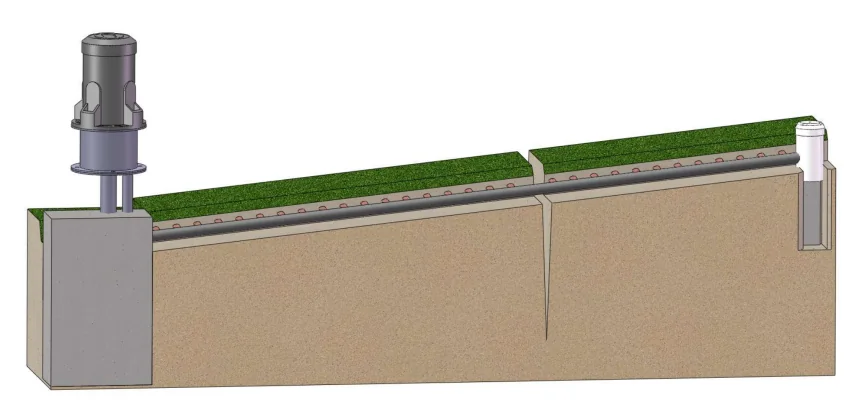
RT-1060 wireless crackmeter installation diagram
RT-1060 Wireless crackmeter installation diagram
2 m
Draw-wire displacement range
0.1 mm
Displacement resolution
IP68
Complete-device protection; underwater use
60 months
76 Ah lithium thionyl chloride battery; 4G reporting every 2 hours

Measurements

Crack opening, tilt and acceleration

01

Crack opening

2 m measurement range, 0.1 mm resolution and ±0.1% FS accuracy.

02

Three-axis tilt

±90° range; accuracy ±0.005° within ±15° and ±0.01° within ±90°.

03

Acceleration and vibration

Three-axis acceleration measurements, vibration frequency and amplitude. Applicable vibration amplitude: 10 mg or greater.

Benefits

Submerged operation and event reports

01

IP68 sealing for submerged use

The complete device is sealed to IP68 for crack measurement when submerged.

02

Immediate crack-change reports

Low-power monitoring tracks crack opening between scheduled reports. A triggered change sends the data immediately, without waiting for the next scheduled report.

Applications

Applications

Landslide surface movement

Unstable rock cracks

Bridge expansion joints

Long-travel structural movement

Specifications

RT-1060 Specifications

RT-1060 Specifications
Measurements
Measurement parametersCrack opening, tilt and acceleration
Draw-wire displacement range2 m
Displacement resolution0.1 mm
Displacement accuracy±0.1% FS
Tilt range±90° (X, Y and Z axes)
Tilt resolution0.001°
Tilt accuracy (within ±15°)±0.005°
Tilt accuracy (within ±90°)±0.01°
Tilt temperature drift<0.01° (−20 to +50°C)
Acceleration range±2 g (X, Y and Z axes)
Acceleration resolution0.01 mg
Acceleration accuracy±0.1 mg
Vibration frequency range1–128 Hz
Vibration frequency resolution1 Hz
Vibration amplitude resolution1 mg
Vibration amplitude accuracy3 mg
Applicable vibration amplitude10 mg or greater
Communications and acquisition
Sampling interval0–24 hours; default: 2 hours
Scheduled reporting interval0–72 hours; default: 2 hours
Communications2G/3G/4G/5G cellular; optional LoRa
Event reportingImmediate reporting when crack movement triggers an event; three threshold levels with real-time reporting and local alarms when exceeded
Communication protocolDZ/T 0450-2023 (Geological hazard monitoring data communication requirements); MQTT 3.1.1
Power and environment
Power supplyBuilt-in 76 Ah lithium thionyl chloride battery
Built-in battery capacity76 Ah
Average power consumption<2 mW (2-hour acquisition and reporting cycle)
Battery life60 months with a built-in 76 Ah lithium thionyl chloride battery and 4G reporting once every 2 hours
Housing materialHigh-strength, aging-resistant engineering polyurethane
Product weight1.5 kg
Operating temperature−40 to +85°C
Mean time between failures (MTBF)60,000 hours or more
Ingress protection ratingIP68 (complete device; suitable for underwater use)

Product support

Questions about this product?

Product data sheets and configuration details are available from our engineers.

Contact us

Frequently asked questions

Can it operate underwater?

The complete device is sealed to IP68 for displacement monitoring when submerged. Follow the specified installation and connector-sealing requirements.

Does a triggered report wait for the next scheduled upload?

A triggered crack change is reported immediately. Scheduled reporting is separately configurable from 0–72 hours, with a default of 2 hours.

What does the battery-life specification assume?

The 60-month specification uses the built-in 76 Ah lithium thionyl chloride battery and 4G reporting once every 2 hours.

Which communication options are available?

2G/3G/4G/5G cellular networks are supported. LoRa is optional.